Online motorcycle auctions have well and truly arrived, but are they really better than getting yourself along to an auction? Simon Robinson gives us the big picture…
Auctions are as old as the hills. Or more likely, as old as the time Person A found out Person B and Person C both wanted to buy his hill and he wanted as much for it as he could get, so he pitted them against each other. The traditional auction method of people viewing, bidding (via a wave, nod or a wink), paying up and removing or taking ownership of the thing they’ve bought – houses, hills… – then remained pretty much unchanged. The big change came with the introduction of online auctions, which really kicked off with the advent of eBay, or AuctionWeb as it was known in 1995, when in America, Pierre Omidyar set up an online marketplace and made his first sale: a broken laser pointer to Canadian Mark Fraser. Dedicated online automotive auctions followed not long after, with Copart in the late 1990s/early 2000s, and since then, the market has expanded steadily.
Bonhams has been hosting online auctions for a while, but in the last couple of years, the motorcycle department has joined the party, now staging three annual online auctions specifically for motorcycles. As one of the biggest names in vintage and classic motorcycle auctions, with its twice-yearly sales at the Stafford show, it seemed like a logical move.
Enjoy everything More Bikes by reading the MoreBikes monthly newspaper. Click here to subscribe, or Read FREE Online.

The processes
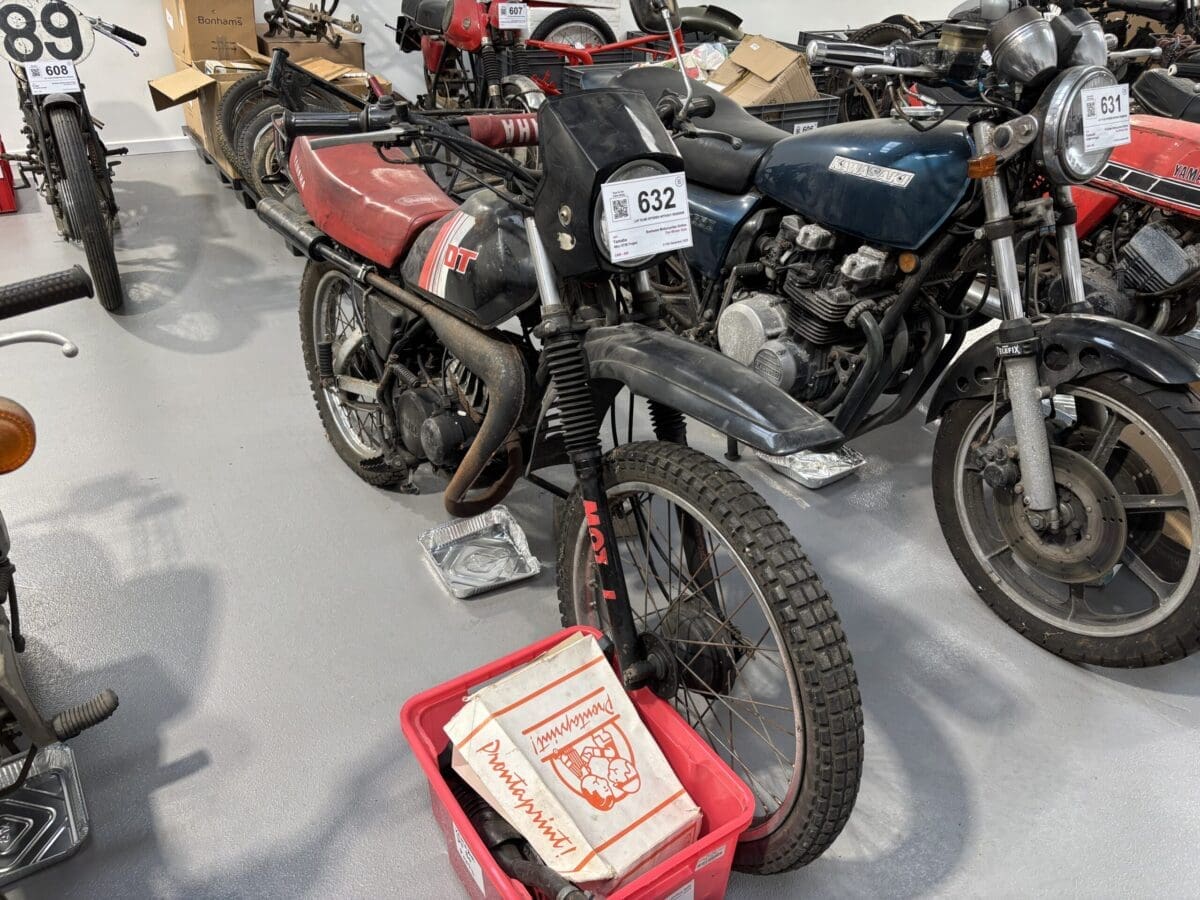
So how does an online auction work? From a buyer’s perspective, Bonhams offers the chance to view the bikes in three dimensions at its motorcycle HQ in Milton Keynes on one of two viewing days, with customers booking a time slot to see all bikes and spares lined up for inspection. To do this, you must register as a potential buyer via the Bonhams website, www.bonhams.com. Once inside, viewers are largely left to their own devices. Bonhams experts are on hand to answer any questions and to go through paperwork or information as required. It felt like a far easier, more personal and relaxed way to view a bike at your own pace and without the bustle and cram of a live auction.
Once the auction opens online, bids are submitted via the relevant button – the equivalent of raising a hand at a live sale – so it’s a hammer-price bid excluding any fees and taxes. You can increase your bid if the price rises, or you can place a maximum bid, in which case the system will automatically increase it in sensible increments until your limit is reached. For instance, if you enter a maximum of £2500, and the bidding starts at £600 and rises in £50 steps until it hits £1500 (the next highest bid), you’ll win it at £1550 (plus fees). Of course, you can also watch live and place bids manually at the last minute.
From a seller’s point of view, the online auction is much the same as a physical one. The machine’s details are discussed, estimates agreed, and the bike delivered to Milton Keynes, either by the seller or a transport company. The bikes are held until the auction concludes, monies are sorted, and the motorcycle or spares are collected by the new owner.

For and against
It’s easy to see the pros and cons for both formats. A physical auction is an exciting event. Buying a bike is often one of the bigger purchases many of us will make, and it’s nice that the whole process feels like an occasion. Nerves rise as your lot approaches, and you’re constantly watching how general prices are going. Chins wag, opinions fly, hopes are realigned, and when your lot appears and bidding begins, the adrenaline flows. It’s a genuinely immersive experience.
But physical auctions have their drawbacks. They are fixed events: you have around two-and-a-half minutes to make your decisions. Prices mentioned are ‘on the hammer’, with fees and taxes added after, so if you’re on a tight budget, you need to calculate all that in advance. Auctions may not be local, meaning a trip to the other side of the country, or even abroad. You can bid remotely by telephone or online, but this carries the anxiety of trusting your tech and being available at the exact time your lot appears. Bids left with the auction house are often only taken second to live bids of the same amount. If you’re attending in person, you might also factor in travel and entry costs, which may be off-putting if you’re after spares or lower-value items. Plus, you’ll often need to arrange transport for the bike quickly as auction companies vacate venues promptly.
Like for like
Comparing like-for-like machines to assess pricing differences between online and physical auctions is tricky. Prices can spike or dip depending on who’s looking for what at any given time. That said, comparing the Stafford auction with the summer 2025 online sale suggests values are broadly aligned.
In the online auction, a 1962 Triumph Tiger Cub sold for £1495, while a similar (perhaps slightly less complete) 1962 version sold for £1265 at Stafford – a fair difference. A 1929 Brough Superior 680 project (lot 603) made £33,280 online, while a 1928 example (lot 341) fetched £34,500 at Stafford. A 1974 Ducati 750 GT fetched £19,550 online (lot 502), while another (yellow) at Stafford (lot 247) sold for £13,225. A 1929 Big 4 with Model 18 engine (lot 533) made £8050 online, compared to £8625 for a 1930 Model 18 at Stafford (lot 292). Two T140 Bonnevilles, one 1977 UK-spec and one 1978 US-spec, each sold for £3450 in their respective sales.

The winter online sale
So how did Bonhams’ online sale (5–15 December 2025) perform? The top three lots were no surprise – although the amounts realised may have been.
Well documented in the run-up to the sale, the trio of fire-damaged V-twins from Alain de Cadenet’s estate comprised a 1954 Vincent Black Shadow and two Ducati bevel V-twins: a 750SS and a 750 Sport. All three had been stored together and suffered heat damage. When viewed, they were kept in a sealed area, with masks provided. Even days after being moved, the smell lingered.
The Black Shadow was a late Series C and fetched £69,000, as did the 1972 750 Sport. It was suggested the Sport may have been a rare ‘Z-stripe’ model, with a trace of orange paint on the petrol tank. Its numbers checked out, despite paperwork perishing in the heat. Whether it will be restored or preserved as-is remains to be seen.
The 750SS had more known history, having been raced by Charlie Sanby in the 1974 and 1975 TTs, finishing 12th and 20th respectively. Though its documents also burned, its provenance was strong. It was first registered for road use in 1976 and was acquired by de Cadenet in 1997. A photo of it appears in Ian Falloon’s The Book of the Ducati 750SS (pages 100 and 102). It sold for £92,000 including premium.

Breaking the V-twin trend, a V-four Honda RC30 was next at £34,500, followed by another Brough Superior 680 project at £33,280. An 1898 MMC Werner, with its engine mounted above the front wheel, sold for £17,250. Featured in Motor Cycling in 1952, it had last been on the road in 2003. Bonhams noted renewed strength in early veteran motorcycles, with encouraging market results.
It wasn’t all high-end exotica, though. Many affordable machines, spares and projects went under the hammer, with 164 of 166 lots sold (£602,000 realised) – more than any other online motorcycle sale in 2025. That total compared favourably to the £275,000 low estimate. Bidders participated from 28 countries.
In conclusion
In 2025, Bonhams held five motorcycle auctions: the two physical Stafford sales in April and October, and three online. The figures underline that Stafford remains king, but online is increasingly important. One suspects the ‘event’ sales will continue, but so too will the rise of the online format.