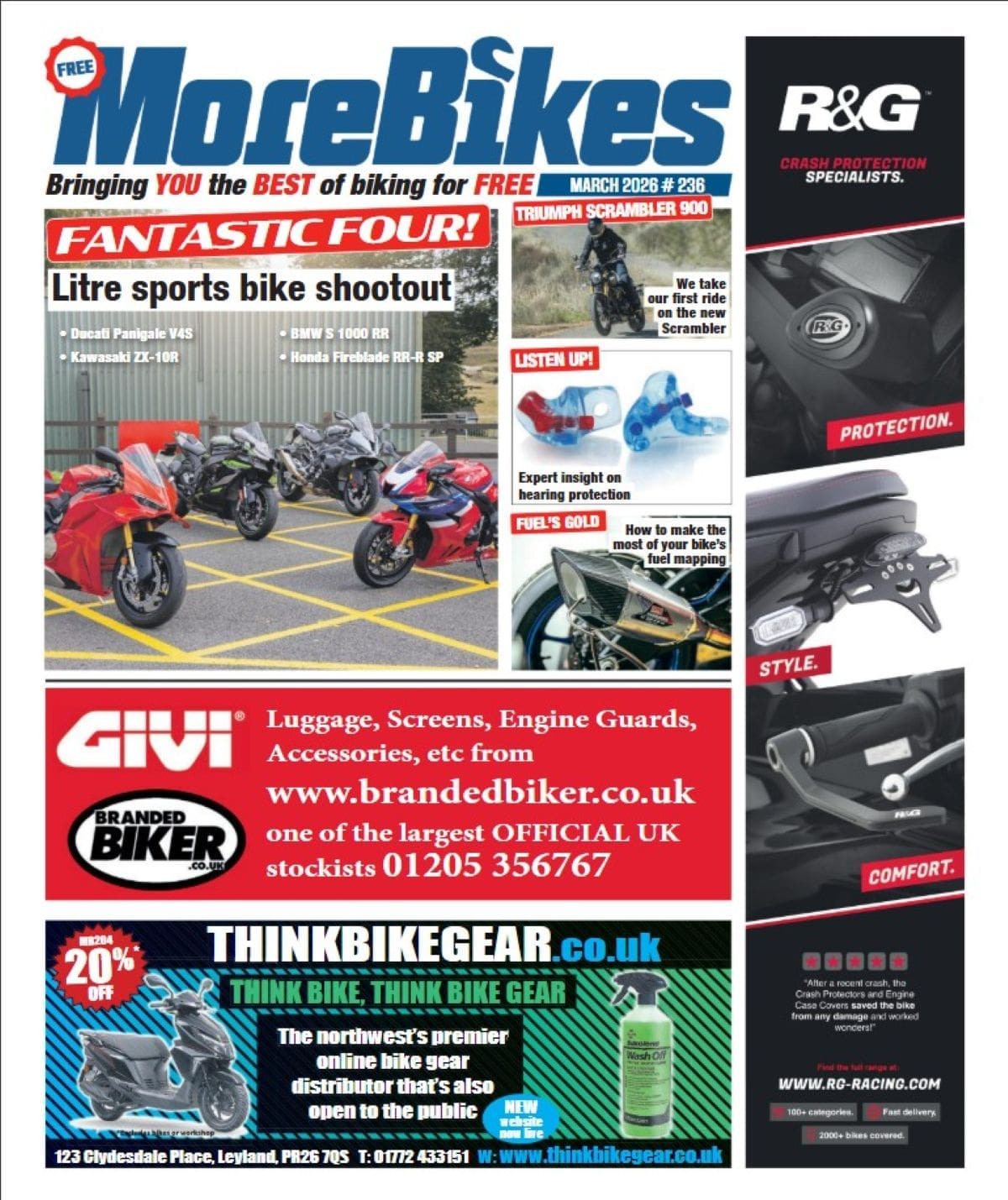
Hot on the heels of Honda’s headline grabbing, scantily clad Hornet, the GT version takes the same formula but gives it a comfort inclined makeover.
With the sport-touring corner of the motorbike market growing in popularity, Honda have decided to throw their hat into the ring with this CB1000GT offering. By using the same engine and main frame from the popular CB1000 Hornet SP as a starting point to build a touring bike around.
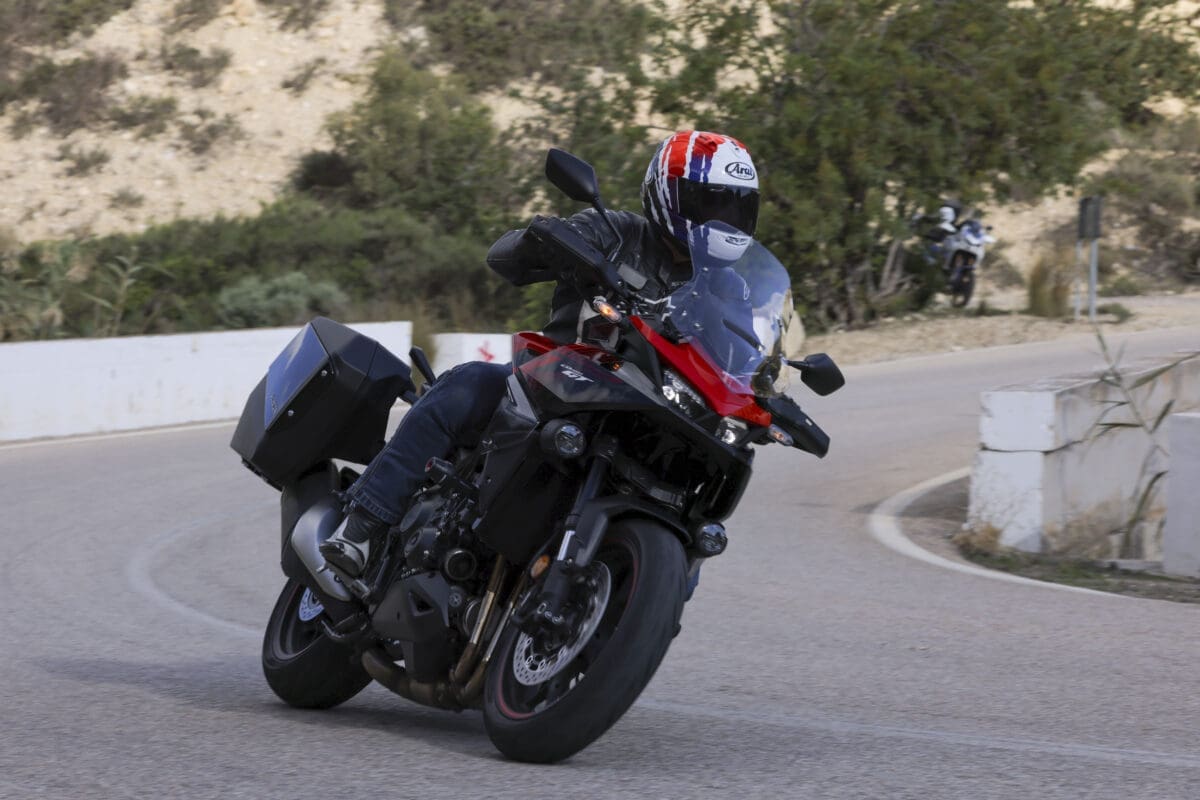
Its crossover 1000cc in-line four powerplant, which itself is derived from the 2017 Fireblade, sees no changes to the internals, though a few refinements have been made within the ECU to allow for a more user-friendly feed of power for the touring option. Acceleration from the lower rev-range is now smoother over the Hornet’s engine and this feel is also noticeable when accelerating hard through the gears. On paper, this slight rework in the electronics has only made a minor difference in power figures, dropping just 7 horses from the Hornet’s total to still provide a healthy 148bhp, with torque also marginally down, but still sitting at 102Nm @ 8,750rpm. The work carried out here proved to make riding through towns that much easier without sacrificing the rev-happy nature of the engine and this should also make riding with a pillion that much smoother too. As you’d expect, another change to the bike’s formula is a beefier rear subframe to enable potential added weight of a pillion and panniers brimmed with pants. Another key addition is electronically adjustable suspension, which caught me by surprise having not expected it on bike hitting the market at just £11,999.
Enjoy everything More Bikes by reading the MoreBikes monthly newspaper. Click here to subscribe, or Read FREE Online.
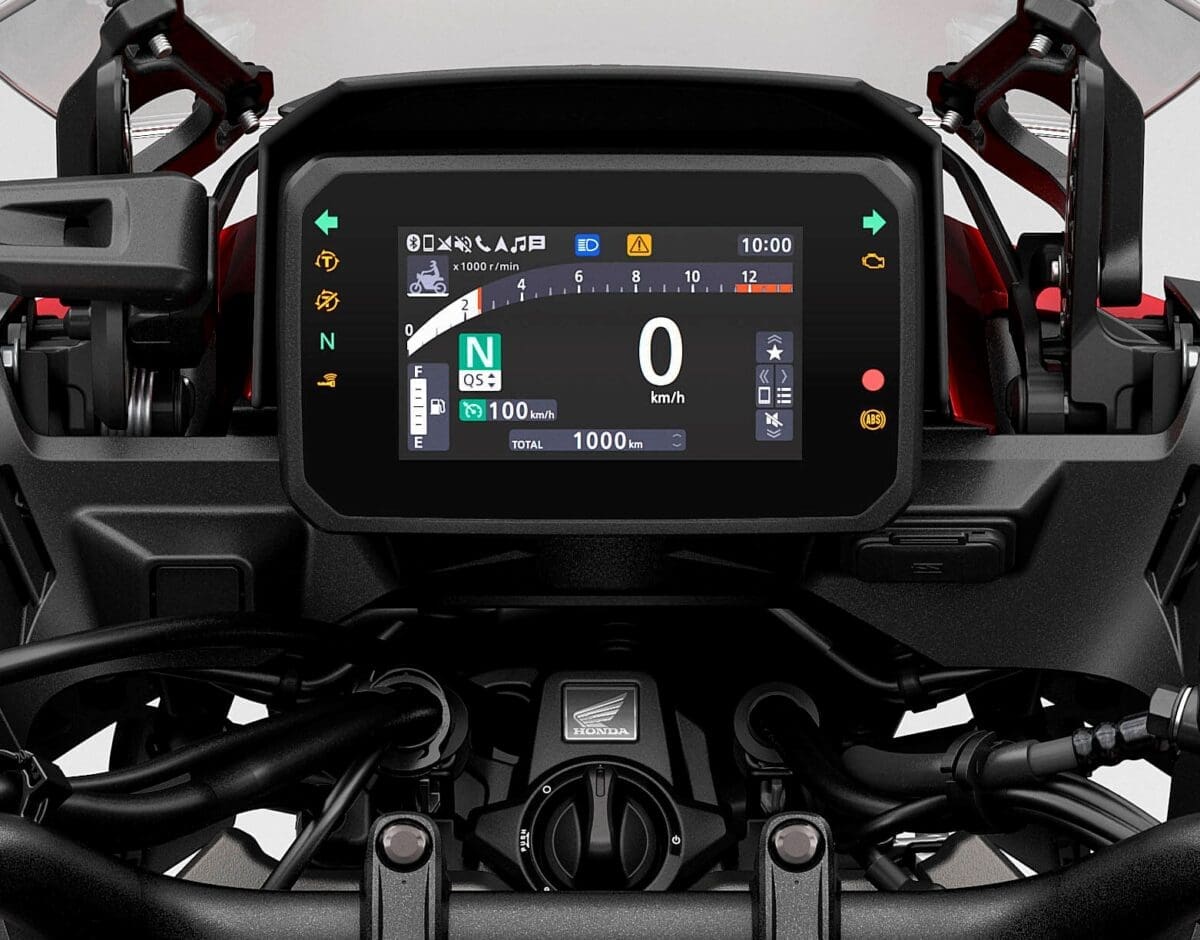
Both front and rear benefit from Showa Electronically Equipped Ride Adjustment (EERA™) suspension with the option to further fine tune the preload manually at the front and through the settings for the rear on the TFT display. While switching between the four programmed rider modes (Standard, Sport, Rain and Touring) also influences the suspension as well as the engine characteristics, selecting the fifth option of “User” mode and diving deeper into the settings on screen allows the rider to adjust the rear preload with 24 levels of increment to discover to allow for extra ride height or when carrying extra weight.
The use of Showa EERA™ for Honda is nothing new, but it is a first for them to use the system on a bike with a high-revving in-line four motor. The set up on the GT has had some fettling to enable it to work more efficiently with this set-up and this is also the first time that a sport mode has been applied to the Showa units. Naturally, when in Standard or Touring mode, the system is optimised for a range of scenarios which enabled a super smooth and stable experience. With my time spent on the GT mainly compromising of smooth tarmac and sunny conditions, switching to the Sport mode was a must for the majority of the day and this transformed the feel and confidence levels significantly.
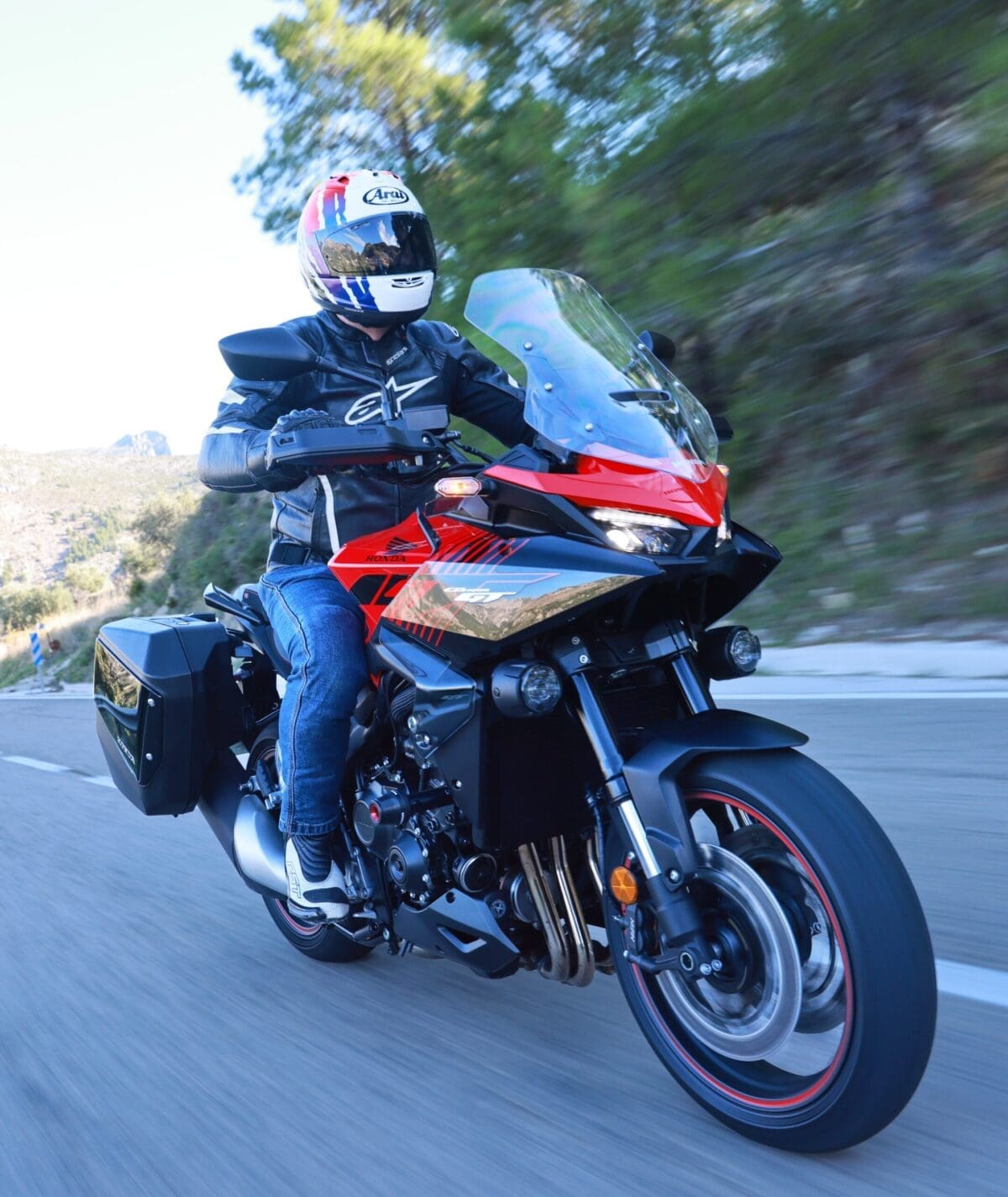
Knowing that the Showa system is collecting data from all over the bike, including suspension stroke, road speed, the ECU and a six-axis IMU, and using all that information to keep the settings optimal in “real time” every 0.015 seconds, is almost inconceivable but without a stopwatch to hand it felt believable. All I needed to know was that in Sport mode the suspension was performing in a way to offer that sports bike feeling with the front end feeling firmer under harder braking and the rear doing its bit by not squatting excessively when firing the GT out of corners when climbing quickly through the revs before grabbing the next gear.
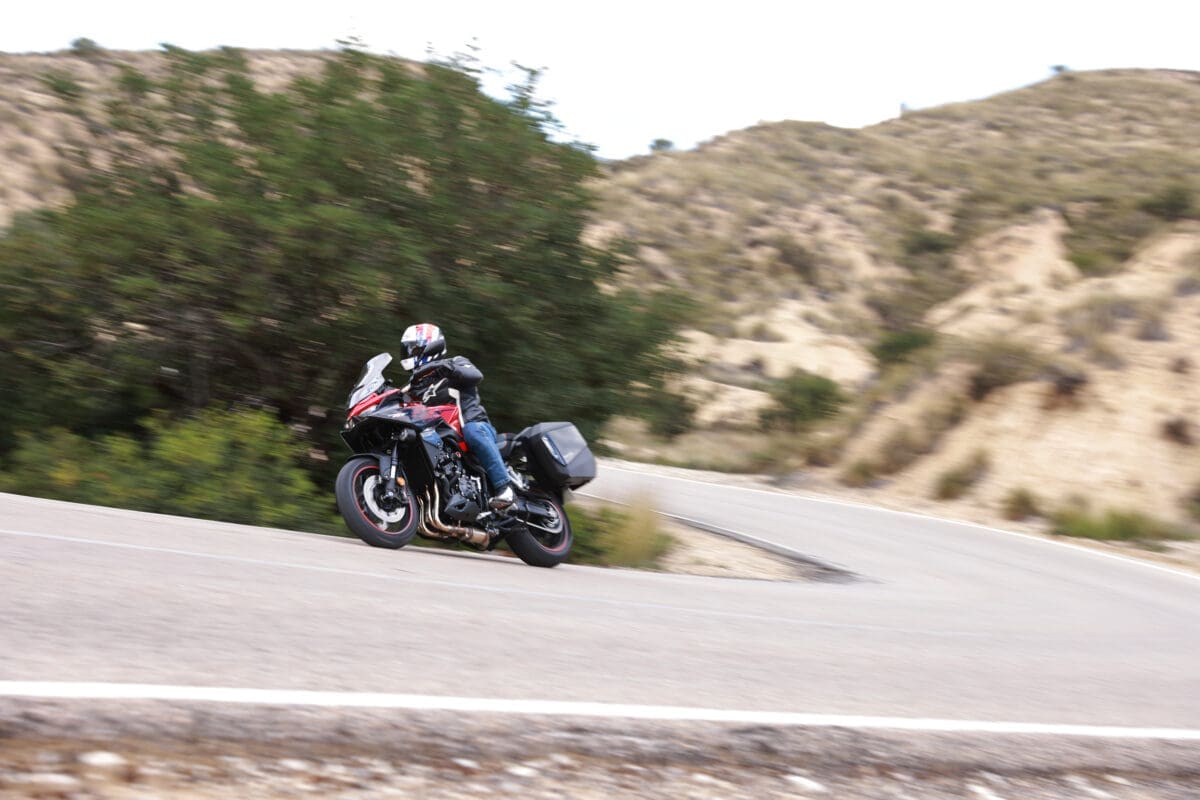
After riding a number of sports-tourers recently, I have often found that when pushing on during a spirited ride, the taller stance and wider bars can sometimes be a hindrance by allowing too much input at the bars when changing direction at pace and making the front end a little lively, so I had just assumed the same would be the case for the GT. Well, I had no issues there, I found that I could get tucked behind the screen accelerating hard through the twisty sections when appropriate and allow what was going on below me to happen in a reassuring manner.
The bi-directional quick shifter fitted as standard was also playing its part here in the smoothness of the riding experience. While these are becoming more commonplace on bikes, some perform better than others and this one was holding its head high by allowing me the chance to make short-shifts seamlessly even at very low revs or by offering easy and seamless gearchanges close to the redline. Coming down the gearbox was equally as impressive, working in harmony with a blipper and the slipper clutch means even the harshest of downshifts were taken in the GT’s stride without protest.
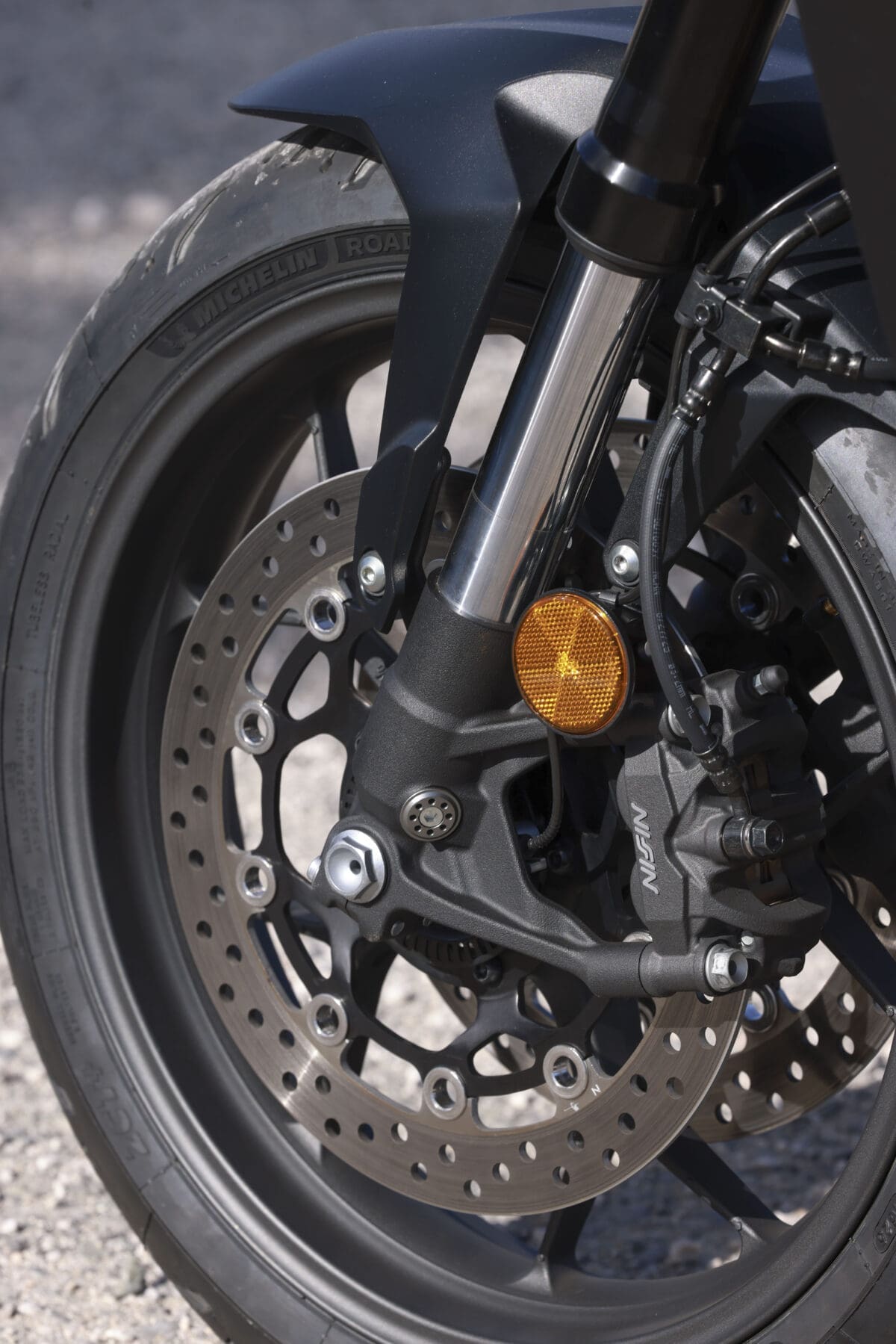
Initially, when looking around the GT before setting off, I noticed that the Brembo brakes from the Hornet SP hadn’t made the cut for this model with the engine and frame but instead there was a pair of Nissin four piston radial callipers to grab the 310mm discs up front. Any initial concerns that they might not be as substantial as I’d like were soon squashed as these proved to be offering all the stopping power, I wanted from them throughout the day. This wasn’t just an on/off brake experience either. The feedback from the initial pull of the lever through to hard braking force was also excelling past my expectations. On another personal note, I sometimes find that I have a riding hangover from my spending time on my first few bikes with their dodgy brakes and so find myself grabbing the brake lever with all four digits. This is something that is becoming less frequent and the brakes on here were allowing me to perform even the hardest of my braking manoeuvres of the day with just a couple of fingers on the lever.
Further brake related tech comes in the form of cornering ABS, and while I wasn’t aiming to push the need for this to be activated, the knowledge of having it onboard is a bonus. I am not going to say I am some world level racer and while I say I didn’t want to push for the need of this tech, the confidence and feeling from the brakes was allowing me to push deeper into the corners allowing for me to even trail brake when required without the ride feeling unsettled.
As if having a decent motor and frame combo, electronic suspension and brake set up is already a great package for a £12k budget, there is a plethora of other features that come as standard on the GT. One such feature that should always be on a bike that can boast touring capabilities is heated grips and the ones here can be activated by a simple switch on the handlebar or via the on-screen settings. When on maximum setting, these grips can get super toasty, but your hands also benefit from the wind protection offered in the form of knuckle guards.
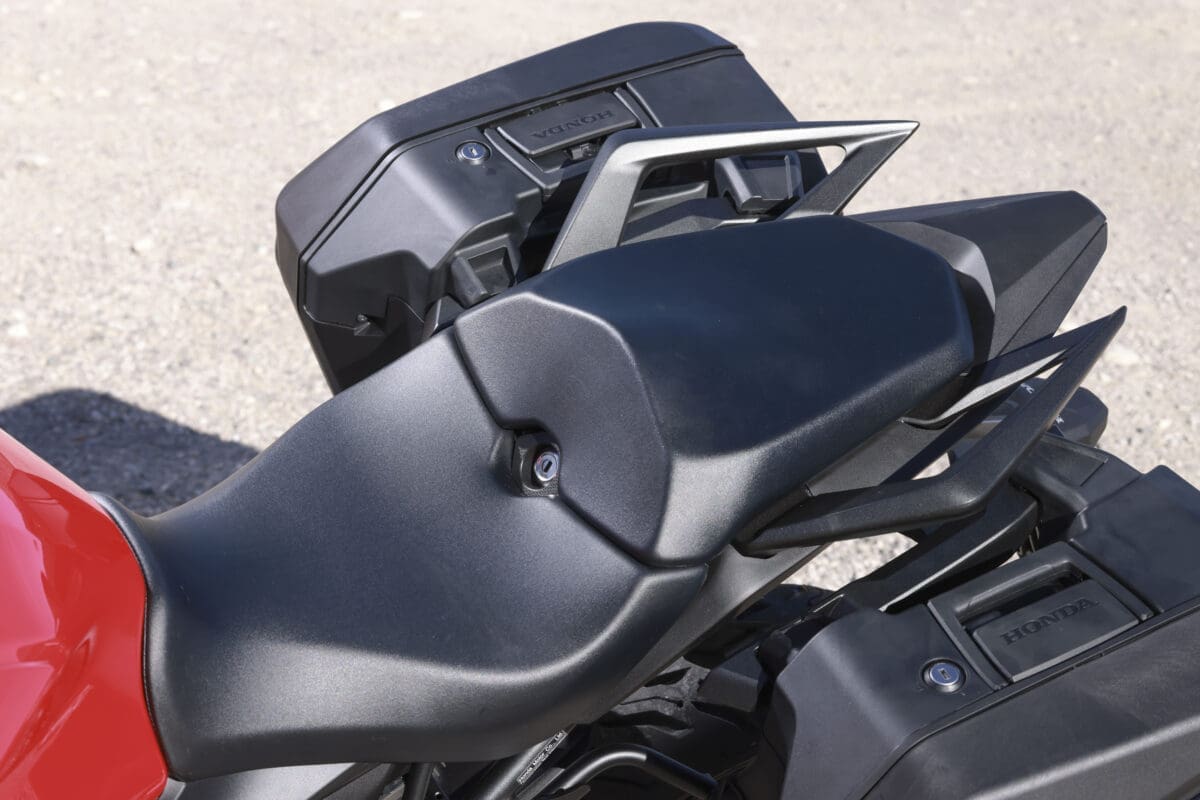
As for the panniers, these are also built into the same price and come as standard. Being “built into” the price could also be perceived as built to a budget but although I do have a couple of issues with them, these are minor details to be fair and overall, the panniers are more than worthy of their place and function as they should. Addressing my problems with them, one is more of a visual matter due to the size of the panniers with the left having 37L of storage and the right side holding 28L. I might be nit picking here and this aspect is only visible from the rear, but, practically, the left can hold a full-face helmet comfortably where, obviously, the left cannot. With the panniers on, the overall width of the bike is still no wider than the handlebars which is always handy to know when needing to filter through traffic and you have just committed to a tight gap. My other slight problem arose when closing them up as I found I needed to hold them shut with a little extra pressure to make sure they would lock properly. This would be something I could live with but at the time I felt it needed a mention.
Honda have got the screen and its operation spot on here. There are 5 different height settings and switching between them is a slick one-handed operation so adjusting on the move is so easy. Adjusting the screen for the first time, it locked into place that smooth and easy I was questioning myself if I had locked it into place correctly. I managed to bag one of the test bikes for the day which was loaded with a “comfort pack” which comprised of a taller screen, comfort seats for rider and pillion, fog lights and some extra wind deflectors on the fairings. This taller screen was keeping most of the wind blast off me and was stable even at the higher speeds on the motorway stretches.
Having just mentioned the comfort seats, I must add here that the design team at Honda have listened to customers’ feedback on ride height and not only have they designed a seat which adds 15mm of padding for the ridder and 10mm for the pillion, but they have done so without adding to the ride height of the bike.
Diving into more of the tech on offer, the GT comes equipped with auto-cancel indicators which also double up as emergency stop signals flashing under heavy braking which may have encouraged me to find this limit to activate on several occasions.
Other boxes that can be ticked off on a practical note are the inclusion of cruise control, a centre stand and an increasingly useful USB-C outlet. The cruise control is easy to switch into, with one button to activate on the right switch gear and another on the left to control speed. The centre stand might not scream sports bike, but this one is tucked as neatly away as possible and if a rider is in fact using the GT for touring, then it is always handy to have when parking on some dodgy surfaces or even for chain maintenance on longer rides.
Riders can connect their phone via Bluetooth to the TFT screen which incorporates Honda RoadSync. This is a useful feature to have allowing one to access calls, music, messages and navigation in the form of turn-by-turn directions on screen. Having this built into the screen would be a big bonus for myself as an owner as it means I can still use my phones navigation while my already cracked and aging smartphone can be tucked away keeping dry.
Overall, in my opinion the GT is a great package, and I don’t mean just good for the money. It is fully loaded with all the trick parts and tech that can be optional extras on other bikes which naturally also adds to the costing. I have hinted earlier that it could be all too easy to assume that for all the bells and whistles you get on the GT for the money, that they would be inferior options. No aspect of the bike here looked or felt like corners were cut in the design process and it is clear to me that a lot of thought has gone into the final product. As a sports tourer the GT is a healthy mix of both disciplines offering an all-day riding position with an abundance of comfort while having that sporty in-line four motor and lightning responsive electronic suspension for the more spirited of rides when required.