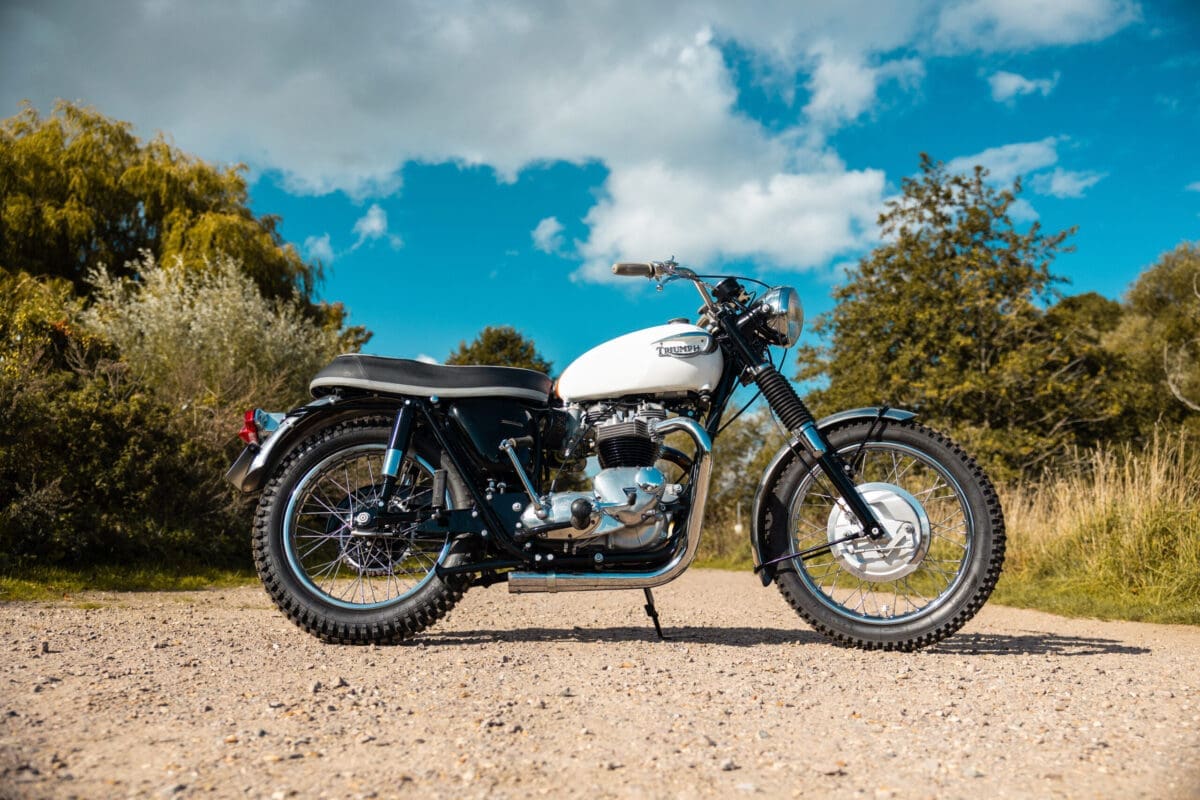
Every bike has its past, but James Robinson explains why this 1966 US-spec Bonneville has a history to rival the best of them.

This is a story which begins in 2005, now a scarcely believable 21 years ago, when I decided that what I wanted was a 1966 Triumph Bonneville. The reason being, then group editor Gez Kane and I had gone to see Hertfordshire-based Triumph restorer Hugh Brown and ridden his two immaculate 1966 US-spec machines, which had been built for other people, and while we were there, I also rode Hugh’s 1970 Bonneville too and, while I reckon Hugh’s own fully sorted bike is the best classic Triumph I’ve ever ridden – and probably the best of all the Triumphs I’ve ridden, thinking about it, in terms of taking into account age and such – it was the pair of 1966 bikes with which I was smitten. My resolve then was to have one of my own; it had to be a US specification though.
There are of course many reasons and logical discussions to be had regarding which year of Bonneville is best, nuanced debates about which one is better than which one, and so on. The general conclusion is that the 1968-70 is the ‘king of the Bonnevilles’ but for me, it had to be a US-spec 1966. Why? The red viper stripe over the top of the white fuel tank and the light grey handlebar grips. Ridiculous reasoning? Why, of course, but then if we tried to think logically about much of this old motorbike malarkey, then it soon becomes troubling. So, it’s best to just go with it, I find.
Enjoy everything More Bikes by reading the MoreBikes monthly newspaper. Click here to subscribe, or Read FREE Online.

Brief Bonnie recap
The Bonneville was launched in late 1958, for the 1959 model year. Its name was taken from Johnny Allen’s 1956 record-breaking exploits with a Triumph twin on Bonneville Salt Flats, while the name also sat nicely in the range, with the American-esque-sounding Thunderbird already present and correct, among a streak of Tigers; the collective noun for tigers is streak, apparently. Learned something new there.
The new 1959 Bonneville 120 (as it’s called in the model launch announcement) was basically a Tiger 110 with the performance ‘comprehensive conversion kit’ – as Motor Cycling referred to it – fitted as standard and given a new name. Being ‘basically a Tiger 110’ meant that the new Bonnie also had that model’s single front downtube frame which, frankly speaking, didn’t enjoy the best of reputations anyway, when propelling the lower-powered offerings – the 500cc Speed Twin and Tiger 100, the 650cc Thunderbird and Tiger 110 et al – so with the newcomer making a claimed 47bhp, things were going to be on the edge of capable. And so it proved, meaning that come 1960, the Bonneville’s pre-unit engine was now housed in a new twin front downtube frame, which improved things no end. The model also lost its 1959 nacelle, which was at odds with the Bonneville’s sporty name and potential anyway, with in its place the quickly detachable front headlight a la the Trophy. Also gone was the 1959 orange-and-cream paint scheme, though actually that had been ditched midway through the 1959 model run.
In retrospect, the first-year ‘Tangerine Dream’ machines have gained status, but in period, the 1960 model marked a significant step forward and was to remain, for the most part, unchanged for the 1961 and 1962 seasons as well, albeit there was an inkling of which way Triumph was headed, as the unit-construction 350cc Twenty-One had debuted in 1957 and was joined by 500cc versions (the cooking Speed Twin and hot-stuff Tiger 100) in 1959. So it will have come as no surprise to anyone when, for 1963, all the 650cc models became unit-construction too, albeit the Tiger 110 was no longer on the scene, so it just left the Thunderbird, Trophy and, of course, the Bonneville. This was arguably the beginning of the Bonneville’s ‘golden years’, with the 1963-70 unit machines offering the best of all worlds, at least according to many.

The 1963 Triumph range also saw a ‘Baby Bonnie’ introduced too, in the form of the 350cc Tiger 90, which was finished in the same colours as the range leader, being, in 1963, Alaskan White, generally with a gold stripe on the mudguards. Interestingly, though, the ‘baby’ didn’t share the Bonnie’s twin carbs, though the 500cc Tiger 100SS did, but that was given a different colour scheme.
The first-year unit Bonnie used cycle parts obviously related to what had gone before, though, over the next few years, these were developed and refined, as the Bonneville established itself as the glamour puss not only of the Triumph range, but, arguably, the whole British motorcycle market. There were pretenders to its throne, from in-house in the form of the BSA (owner of Triumph since 1951) A65 Spitfire and the Associated Motor Cycles stable, mainly with Norton’s 650SS and Atlas (and perhaps 650cc CSR AJS/Matchless twins) but, really, the Bonneville outstripped them all.
The reasons? Well, they were lighter and so felt faster to start with, plus they just looked so great too, greatly helped by the carefully chosen colour schemes which always looked brilliant and had great names too; gold and cream in 1964, Pacific blue and silver in 1965, Grenadier red and Alaskan White in 1966, aubergine and gold/Alaskan White in 1967, then Hi-Fi scarlet and silver in 1968, Olympic Flame and silver in 1969 and, in 1970, Astral red and silver.

In 1971, Triumph had a redesign and the Bonnie was changed for ever, as a new oil-in-frame (OIF) chassis was introduced, which was the first step on the route to what was to become the 744cc T140, albeit on introduction the new set-up met with criticism and was subsequently rejigged. The T120 was joined by the T140 (though anyone with hopes of screwing 140mph out of one was to be sadly disappointed) which was the final incarnation of the ‘original’ Bonneville, though it is amusing to think that the new Bonneville (launched in 2000) has enjoyed a longer uninterrupted run now than its predecessor; the first machines at Meriden were 1958-83, with the new ones already a year longer… And counting. So which one does that make the ‘real’ Bonneville then? But I digress.
This machine
Back to the matter in hand. Having ridden a few of the aforementioned Hugh’s Bonnevilles for magazine features over the years, I was always half on the lookout for something, shall we say, ‘suitable’. And then, a conversation with my friend, and founder of the car magazine Jaguar World and our occasional contributor, Jim Patten, elicited the following response:
“New York-based Jack Miller is a reader of Jaguar World and we got into exchanging emails and found a lot in common, so much so we visited him. Jack owned a 1966 E-type, 3.8 Mk 2, a Porsche 911 that he bought new in 1988, his dad’s Model A Ford, 1964 Corvette split rear window (made in that year only) and assorted other American cars. He also had a 1966 Bonneville that he bought from the original owner in about 1986. He had the tank painted in aircraft black and fitted a pair of later carbs. Jack used it only now and then but took the miles up to 9500. I tried to buy it from him but although an injury stopped him riding, he wouldn’t sell. Then the Sandy floods hit New York and a lot of his collection went under water. His Porsche floated away, the Model A was damaged and the Bonnie went under. I immediately got him to hose it down, drain every fluid and fill with diesel. He’d lost heart and agreed to sell it to me.
“I had no idea what to expect. It looked an absolute shed when it arrived. Both wheels were shot. I put it on the bench and drained the fluids again, and although it was mostly diesel, there was some water. Fortunately not salt water. A little dismayed, we started the stripdown and I just could not believe the condition. The frame could almost be wiped down and used. But that’s not my way. The frame and tinware all went off to CL Classics to be painted black, the tank is still with them while James the painter sorts out the Grenadier red stripes over Alaska White.
“The pistons were seized and had to be persuaded to leave, but all done now. Thurstons took the undamaged barrels out to +020 and supplied new pistons. Peter Trent did the head with new fancy guides, seats and valves. Chris Applebee balanced the crank. The castings are in superb condition with no damage or corrosion. I noticed a few blemishes on the gears and managed to track down a complete set of new old stock gears and selectors. I have in stock new but shop-soiled original Dunlop rims, a new TLS front hub, and other various parts. Also have a QD rear hub on the shelf. Mechanically, it is dismantled but machining done.

“Bought all new bearings (top makes) from Essex Bearings, who I know well. Have new aftermarket stanchions, rear shocks and ’bars. Front and rear guards are good but not perfect. In one area, I am going against everything I stand for, and intended to reuse the harness. It is so subtle and pliant that I’d rather have this than a repro.
“Have held back on the chrome. Headlight shell done and am waiting for the instrument bracket and one top fork nut to arrive. I resist chroming if the original parts are good. Instruments all respond to spinning a cable but I would have them overhauled, if only for the cosmetics.
“As you can see, most of the money has been spent, but the wheels still need spoking, instruments rebuilding and possibly other stuff too that I can’t think of right now. I would buy a repro seat for riding but keep the original to one side. But there is no reason why it cannot be fitted.
“My plan was to put it on eBay with bidding starting at £6K, the minimum I would take from an unknown punter. But we can arm wrestle over that. I will include the few Triumph tools that I have, plus workshop manual, originality guide etc.”
Of course, on reading that email I was helpless. I had to have it. Only problem being that when the message landed, in the middle of 2021, I’d just moved house and finances were, shall we say, a little stretched. I explained my predicament to Jim and, being the gent that he is, he came over and had lunch and we came up with a solution, insomuch as I sold my modern Kawasaki trail bike and a few bits and pieces and was able to give him half the required £6000 on collection, then pay him the balance over the next three months, on payday…

So off I went to collect the Triumph, packing it all into the van and bringing it home, flushed with enthusiasm but also realising that there were a lot of bits there and while it would probably be relatively straightforward for someone, I wasn’t sure I was that someone. Anyway, not long after bringing it all home and stacking it up in the shed, Hugh was out visiting family near where I live and so I enticed him round with a free lunch. And to inspect my purchase, possibly with the cunning plan of me getting him to finish it off.
Plans being made and unmade
Hugh is a perfectionist and, on looking at my kit, started to highlight things. First comment was that the beautifully painted fuel tank was ‘probably genuine’ but that the white was ‘too white’. Then there were other things such as the later primary chaincase, a heavyweight crankshaft, the rear chainguard was from 1970, a beautifully painted side panel was missing the correct 1966 tab, the bottom yoke was a UK (not US) one and there were sundry other things too. But he explained that while he’d do the bike if I wanted him to, everything – including the later twin-leading-shoe front brake – would need to be changed back to 1966 spec, while the paintwork would need redoing, specifically the fuel tank. I said I wasn’t particularly bothered about the paint or brake, but Hugh insisted; “If I do a bike, it’s my name and reputation on it. If it’s the wrong colour, or the wrong chainguard, some people will think I’ve got it wrong and so that’s why, if I do it, it will all need to be correct.” And I couldn’t argue with that, but I also couldn’t reconcile myself to repainting what to me looked a perfectly good fuel tank and in all honesty, a 1970 chainguard was as good as (or better than) a 1966 one. And I like the twin-leading-shoe front brake. But I also knew and respected Hugh’s reasoning, so decided that I’d tackle the Bonnie myself, once the other list of things that needed doing were done. Including all the work on the aforementioned house.
Anyway, fast forward three years and predictably enough, the Triumph sat exactly where it did when I’d had Hugh come and examine it. I didn’t really know what to do with it; personal circumstances meant it was looking unlikely I’d get round to doing it any time soon, as I’d have enlisted my dad’s help and not only was he not particularly interested in the marque or period, it was also the start of his serious health issues, so that seemed a non-starter. Talking to my friend Matt Hull – editor of Classic Bike Guide – he suggested: “Why don’t you get my friend Matt Marsham to put it together?” And so it began.
Plans being made again
This all occurred in the summer of 2024. Matt Hull had said the other Matt ‘works fast’ – and he wasn’t lying. The two Matts came over in Marsham’s big ol’ American pick-up which they skilfully managed to get round the back of my house, negotiating the very tight lane… And we duly loaded all the Bonnie bits into it. Matt Marsham was genuinely excited by it – he’s a veteran of many Triumph restorations and has his own exquisite T140 – while I was a bit more circumspect, just wanting it back to something vaguely motorcycle-shaped, maybe just to sell on, as my enthusiasm had waned but Matt’s was unabated.

Soon, he was hard at it, and I was getting regular updates and photos, as well as going over to see him and it. But also soon, costs all started to escalate, as what was ‘just’ going to be a straightforward build and maybe sell, started to become a bit more expensive, with new parts being bought and now I was getting carried away too. We had intended to re-use bits, but now, what we were creating was starting to look like a showstopper. And so it turned out, with its new slash-cut TT pipes, wheel rims, bits painted, rebuilt and remodelled, while the original seat – which is a later hinged one – was then recovered exquisitely by Fred, who you’ll have read about and seen the handiwork of in the feature on my brother’s Domiracer in the March issue. Suffice to say, when King Charles acquired a new Lotus recently, it was Fred who did the custom trim for it. It’s not catalogue spec, far from it, but it looks great, all round.
Of course, all this cost a small fortune and again, also of course, my funds were somewhat stretched; Matt sent me invoices and I’d pay them as soon as I could, but he works at such pace, they were coming fortnightly. My birthday presents involved asking for an invoice to be paid, which Dad kindly did. I’ve never looked at the final total, but I think it was the same as the amount, I’d given Jim for the bike in 2021. Gulp.
But what now? It starts, runs and I’ve ridden it, while it looks absolutely stunning. It’s the old irony of ‘it’s too good to use’ and I can’t bear the thought of getting it dirty which means it now just stands, as a beautiful ornament. I keep debating bringing it in the house, but have so far demurred, though I do seriously consider it often, though for the time being, I go and stand in the garage and look at it.
There are a few little jobs (to fit kneepads or not? Plus there are a couple of transfers missing on the tank. And we don’t have air slides in the carbs so have a spare hole on the lever) and fettling to do, which is probably among the reasons I’ve not used it and while I think the pipes and knobbly tyres we chose to fit look great, I do wonder if a standard set of pipes might be better – as then could fit the centrestand spring we’ve had to omit – and ‘road’ tyres might be worthwhile ‘using’ additions. But then it wouldn’t look (or sound) so great, perhaps.
However, my passion is really for older machinery or those which are black and gold and have names starting with ‘V’ so if anyone wanted to give the Bonnie the love it deserves and a new home, maybe only its fifth, then I’d contemplate letting it go. It’s a wonderful thing to have and gives me plenty of pleasure.